

Continuous Viral Load Testing For Transplant Care
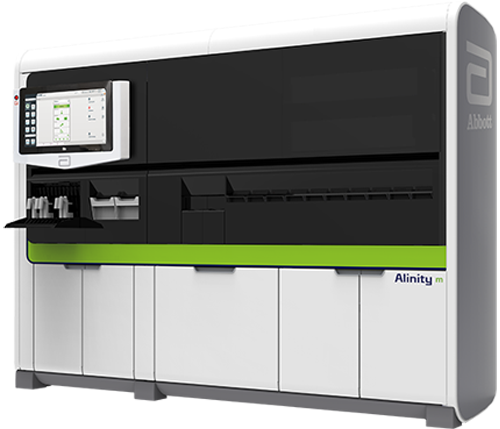
Abbott supports laboratories managing post‑transplant patients with molecular testing solutions designed to accommodate the needs of laboratorians delivering critical viral load diagnostics. The Alinity m system supports CMV, EBV, and BKV viral load testing on a fully integrated and automated molecular platform built to perform reliably in dynamic clinical testing environments.
Beyond the laboratory, Abbott is proud to support the transplant community as a sponsor of the Transplant Games of America, an initiative of the Transplant Life Foundation. Through this partnership, Abbott celebrates life after transplant and honors the resilience of transplant recipients, donor families, and the healthcare teams who support them. Learn more about the Transplant Games of America.



Designed for More Flexible Transplant Workflows
Traditional molecular batch processing can limit flexibility in laboratories managing post‑transplant testing workflows, particularly when testing volumes vary and urgent samples require timely attention. Holding samples until a full run is ready can introduce delays and make it difficult to respond to changing priorities.
The Alinity m system is designed to support post‑transplant testing workflows by enabling testing to begin as samples arrive. With continuous and true random access and STAT capability, laboratories can prioritize urgent post‑transplant samples while maintaining consistent and predictable turnaround times.
Operational Efficiency Through Consolidation
Beyond transplant viral load testing, Alinity m supports a broad molecular menu commonly used in immunocompromised patient populations. By consolidating multiple assays on a single platform, laboratories may simplify workflows, reduce system complexity, and support efficient use of laboratory resources, while maintaining flexibility to respond to changing clinical and operational demands.
What Our Customers Say
“With the Alinity m, you load the samples on and can load them on as they come in throughout the day. If a particular sample fails, you just put that one sample back on without having to rerun the entire batch.”
Sheryl Alberta, MT ASCP MB
Lead Technologist, Corewell Health Grand Rapids Hospital Lemmen Holton
“Our clinicians love that they get test results back within 24 hours, and it is really useful in managing both hematopoietic stem cell transplant patients as well as solid organ transplantations.”
Stefan Reidel, MD PhD D ABMM FCAP
Associate Medical Director, Clinical Microbiology Laboratories, Beth Israel Deaconess Medical Center
Testimonials herein are solicited. The testimonials are representative of customer experience. Experience will be unique and individual to each customer.
Transplant Viral Load Testing on One Platform
Alinity m transplant viral load assays are designed to support consistent and reliable testing workflows. Across CMV, EBV, and BKV, laboratories benefit from automated processing, standardized quantitation aligned to international standards, and time to first result under 120 minutes.
Available assays on Alinity m:

Alinity m CMV Assay
The Alinity m CMV assay is intended for use as an aid in the management of solid organ transplant and hematopoietic stem cell transplant patients undergoing anti‑CMV therapy, when interpreted in conjunction with clinical and laboratory findings.
Specimen typeEDTA plasma | Limit of Detection30 IU per mL |

Alinity m EBV Assay
The Alinity m EBV assay is intended for use as an aid in the management of EBV in transplant patients, with results interpreted alongside other relevant clinical information.
Specimen typeEDTA plasma | Limit of Detection20 IU per mL |

Alinity m BKV Assay
The Alinity m BKV assay is intended to support the diagnosis and management of BKV in transplant patients, when used as part of a broader clinical assessment.
Specimen typeEDTA plasma | Limit of Detection50 IU per mL |
Important Information
Intended Use and Limitations for the Alinity m CMV, EBV, and BKV assays are available in their dedicated section below.
Intended Use
The Alinity m CMV assay is an in vitro polymerase chain reaction (PCR) assay for use with the automated Alinity m System to quantitate cytomegalovirus (CMV) DNA in human EDTA plasma.
The Alinity m CMV assay is intended for use as an aid in the management of Hematopoietic Stem Cell Transplant and Solid Organ Transplant patients who are undergoing anti-cytomegalovirus therapy. The Alinity m CMV assay can be used to assess virological response to anti-cytomegalovirus therapy.
The results from the Alinity m CMV test must be interpreted within the context of all relevant clinical and laboratory findings. The Alinity m CMV test is not intended as a screening test for the presence of CMV DNA in blood or blood products.
Limitations
- Optimal performance of this test requires appropriate specimen collection and handling (refer to the SPECIMEN COLLECTION AND PREPARATION FOR ANALYSIS section of this package insert).
- Human plasma (K2 EDTA, K3 EDTA, and PPT) specimens may be used with the Alinity m CMV assay. The use of other plasma tubes has not been evaluated.
- Debris within plasma specimens (eg, fibrin strands) may interfere with sample processing.
- Diluted specimens must be tested within 2 hours after dilution and should not be frozen.
- The instruments and assay procedures reduce the risk of contamination by amplification product. However, nucleic acid contamination from the calibrators, positive controls, or specimens must be controlled by good laboratory practice and careful adherence to the procedures specified in this package insert.
- Test results are to be interpreted by qualified licensed healthcare professionals in conjunction with clinical signs and symptoms and other relevant laboratory results.
- A specimen with a result of “Not Detected” cannot be presumed to be negative for CMV DNA.
- Due to the potential for variability in CMV viral load measurements across different CMV assays, it is recommended that the same device be used for the quantitation of CMV viral load when managing CMV infection in individual patients.
- Testing of drug resistant CMV specimens has not been evaluated in the clinical study.
- Test performance characteristics have been evaluated only for individuals who have undergone solid organ transplant (SOT) and hematopoietic stem cell transplant (HSCT), and have been diagnosed with CMV disease and are undergoing treatment. No information is available on test performance in patients undergoing other types of transplant procedures, neonates or pediatric patients, or AIDS or other immunocompromised patients.
- This test is intended for use as an aid in the management of solid-organ transplant and HSCT patients who have been diagnosed with CMV disease and are undergoing antiviral therapy. In this population, the test can be used to assess virological response to treatment by measuring the baseline CMV DNA level and to assess the effects of antiviral therapy by measuring CMV DNA during the course of antiviral treatment. Patient management decisions should not be made based solely on the results from this test. Other laboratory and clinical factors must also be considered in making clinical decisions.
- Clinicians should take individual patient risk factors as well as current clinical guidelines into account when using CMV viral load results for the management of transplant patients.
- This test is not intended for use as a screening test for the presence of CMV in blood or blood products and has not been evaluated as a diagnostic test to confirm the presence of CMV infection.
Intended Use
Alinity m EBV is an in vitro polymerase chain reaction (PCR) assay for the quantitation of Epstein-Barr Virus (EBV) DNA in human EDTA plasma on the automated Alinity m System.
Alinity m EBV is intended for use as an aid in the management of EBV in transplant patients. In patients undergoing monitoring of EBV, serial DNA measurements can be used to indicate the need for potential treatment changes and to assess viral response to treatment.
The results from Alinity m EBV must be interpreted within the context of all relevant clinical and laboratory findings. Alinity m EBV is not cleared for use as a screening test for donors of blood, blood products, or human cells, tissues, and cellular and tissue-based products (HCT/Ps) for EBV.
Limitations
- Optimal performance of this test requires appropriate specimen collection and handling (refer to the SPECIMEN COLLECTION AND PREPARATION FOR ANALYSIS section of this package insert).
- Human plasma (K2 EDTA, K3 EDTA, and PPT) specimens may be used with the Alinity m EBV assay. The use of other specimen types or plasma tubes has not been evaluated.
- Debris within plasma specimens (eg, fibrin strands) may interfere with sample processing.
- Diluted specimens must be tested within 2 hours after dilution and should not be frozen.
- The instruments and assay procedures reduce the risk of contamination by amplification product. However, nucleic acid contamination from the calibrators, positive controls, or specimens must be controlled by good laboratory practice and careful adherence to the procedures specified in this package insert.
- Due to the potential for variability in EBV viral load measurements across different EBV assays, it is recommended that the same device be used for the quantitation of EBV viral load when managing individual patients.
- Negative test results do not preclude viral infection or tissue invasive viral disease. Test results must not be the sole basis for patient management decisions.
- Test results are to be interpreted by qualified licensed healthcare professionals in conjunction with clinical signs and symptoms and other relevant laboratory results.
- As with any molecular test, mutations within the target regions of Alinity m EBV could affect primer and/or probe binding resulting in the under-quantitation of virus or failure to detect the presence of virus.
- While elevated EBV viral load may suggest post-transplant lymphoproliferative disorders (PTLD), the diagnosis of PTLD is made based on histological evaluation of tissue biopsy. PTLD may be present without detectable EBV viral load, and an increase in EBV viral load is not necessarily diagnostic of PTLD.
- This test is not intended for use as a screening test for the presence of EBV in blood or blood products and has not been evaluated as a diagnostic test to confirm the presence of EBV infection in an immunocompetent population.
Intended Use
Alinity m BKV is an in vitro nucleic acid amplification test for the quantitation of BK virus (BKV) DNA in human EDTA plasma (K2 EDTA, K3 EDTA, and PPT) and urine stabilized using the Alinity m Urine Transport Kit on the automated Alinity m System.
In EDTA plasma (K2 EDTA, K3 EDTA, and PPT) and urine stabilized using the Alinity m Urine Transport Kit, Alinity m BKV is intended for use as an aid in the diagnosis and management of BKV in transplant patients.
In patients undergoing monitoring of BKV in EDTA plasma, serial DNA measurements can be used to indicate the need for potential treatment changes and to assess viral response to treatment.
The results from Alinity m BKV must be interpreted in conjunction with clinical signs and symptoms and other relevant laboratory findings. Alinity m BKV is not cleared as a screening test for blood or blood products or human cells, tissues, and cellular and tissue-based products.
Limitations
- Alinity m BKV has been evaluated only for use in combination with the Alinity m BKV CTRL Kit, Alinity m BKV CAL Kit, Alinity m Lysis Solution, Alinity m Diluent Solution, and Alinity m Vapor Barrier Solution on the Alinity m System.
- Optimal performance of this test requires appropriate specimen collection and handling (refer to the SPECIMEN COLLECTION AND PREPARATION FOR ANALYSIS section of this package insert).
- Human EDTA plasma (K2 EDTA, K3 EDTA, and PPT) and urine specimens stabilized using the Alinity m Urine Transport Kit may be used with the Alinity m BKV assay. The use of other specimen types has not been evaluated. Plasma and stabilized urine DNA level measurements are not directly comparable to each other and to those of other sample types.
- Quantitation of BKV DNA may be affected by sample collection methods, patient factors (eg, age, presence of symptoms), and/or stage of infection.
- Degradation of BKV DNA in neat urine can affect quantification.13 Transfer of urine into the Alinity m Urine Transport Kit is required to achieve specimen stability.
- Debris within plasma specimens (eg, fibrin strands) may interfere with sample processing.
- Diluted plasma specimens must be tested within 2 hours after dilution and should not be frozen.
- The instruments and assay procedures reduce the risk of contamination by amplification product. However, nucleic acid contamination from the calibrators, positive controls, or specimens must be controlled by good laboratory practice and careful adherence to the procedures specified in this package insert.
- Test results are to be interpreted by qualified licensed healthcare professionals in conjunction with clinical signs and symptoms and other relevant laboratory results.
- Negative test results do not preclude viral infection or tissue invasive viral disease and test results must not be the sole basis for patient management decisions.
- Quantitative variability of BKV DNA inherent to urine has been observed in different aliquots of the same sample (urine stabilized using the Alinity m Urine Transport Kit).
- Due to the potential for variability in BKV viral load measurements across different BKV assays, it is recommended that the same device be used for the quantitation of BKV viral load when managing individual patients.
- Assay interference was observed with mucus at >0.4% w/v and peripheral blood mononuclear cells (PBMCs) at >1 × 10⁵ cells/mL in urine specimens.
- Performance characteristics for BKV subgroup/subtype Ic and II were established using armored DNA only.
For In Vitro Diagnostic Use. Rx Only.